OpenCode 2 versus direct editing: does one button need an agent?
Compare output, time, compatibility, friction, automation and intended users for one HTML input, without invented benchmarks.
Last updated
Menus and supported features can change. Compare the source-check date below with your current app version.
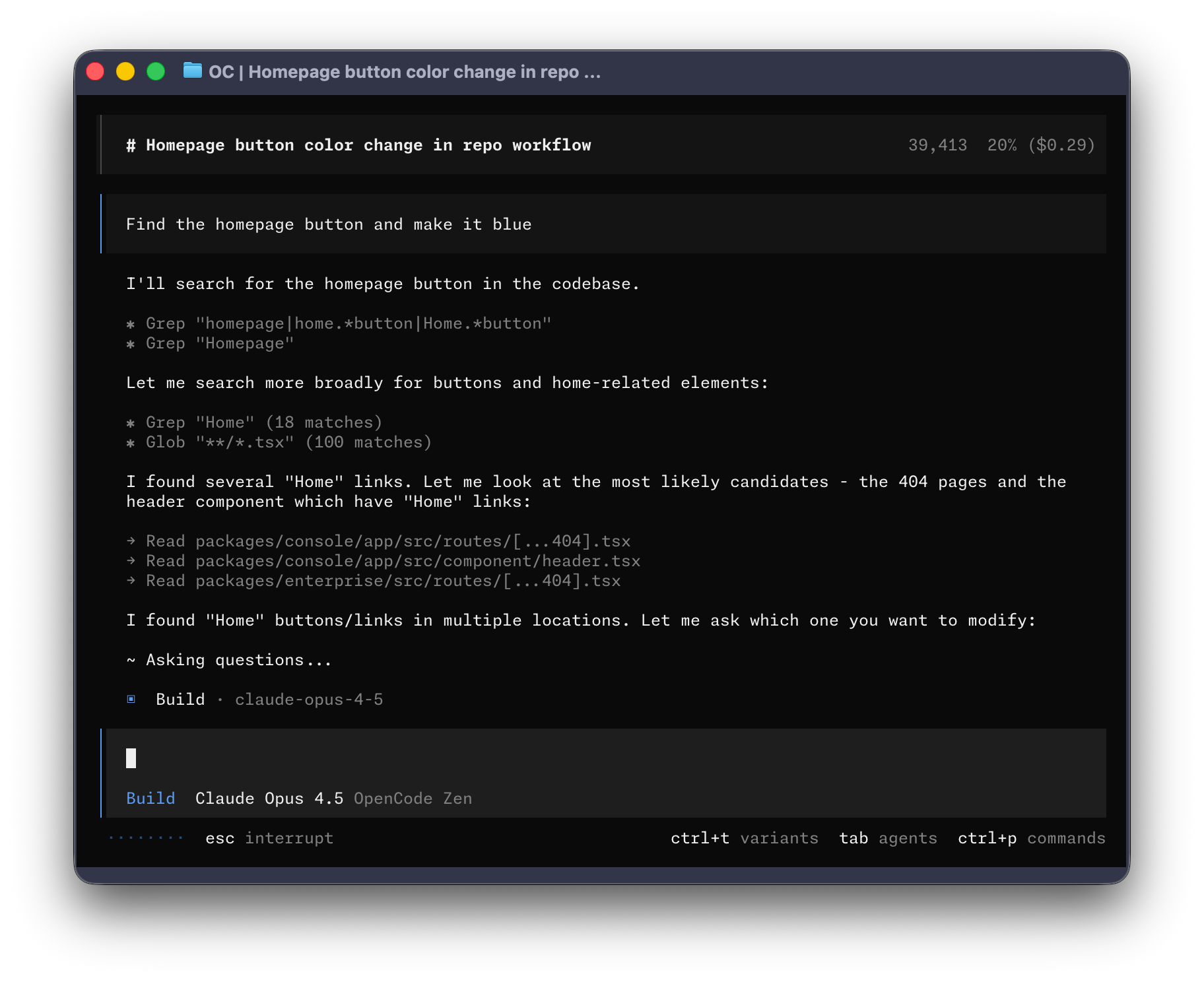
For one button-label change, should you start a coding agent or simply edit the file? BumbleV’s comparison sets OpenCode 2.0.30 against direct editing with a text editor and Git. Rather than switching between competing models and inventing a speed contest, the aim is to identify what each route delegates and what the human still has to verify.
This is an official-documentation comparison, not a hands-on benchmark. There are no observed task outputs, timings or success rates for either route. See the introduction for product context and the button-label tutorial for the exact input. Nothing here establishes a developer-replacement claim or a measured productivity gain.
What changed on October 15?
The useful 2.0.30 update concerns inspection after a request. On desktop, Settings → Preferences → Timeline → Changed files shows a completed turn’s changed files, line counts and expandable diffs. In a terminal session, /diff opens a docked viewer; f expands it. That puts the agent’s conversation and its file changes closer together.
V2 also uses a shared service across terminal, desktop and web clients by default. Changing the interface does not by itself improve the model or make a task faster. A meaningful comparison must control the provider, model, project, permissions and acceptance conditions. I checked the version tag and official changelog separately; October 15 is not presented as OpenCode 2’s first-ever launch date.

Use exactly the same input
Start with the tutorial’s index.html. Change only Start to Open guide, preserving the #guide target, CSS, headings and other text. In the manual route, edit that text yourself. In the agent route, give the same requirements and inspect the proposed action before approval. Both routes end by reopening the source and clicking the link in a browser.
| Dimension | Direct editing | OpenCode 2.0.30 | Not measured here |
|---|---|---|---|
| Output | HTML edited by the person | HTML changed through the selected model and tools | Scope errors, typos and corrections |
| Time | Locate, edit and verify | Connect, prompt, approve, wait and review | End-to-end time and repeat-task time |
| Compatibility | Editor and browser read the file | Tools operate on local project files | Real behavior in other frameworks |
| Friction | Find the right location yourself | Also manage authentication, permissions and service state | Recovery and manual cleanup effort |
| Automation | Repeated work needs a separate script | Non-interactive opencode run is documented |
Approval handling and unattended recovery |
| Intended user | Someone who knows the location and needs a small edit | Someone exploring unfamiliar code and reviewing proposals | Net benefit in a particular project |
The time column names stages to record, not measurements. In unfamiliar code, finding the correct location may dominate the task. When the location is obvious, connecting a model may cost more effort than editing. The sources do not tell us which route is a particular number of times faster.
A diff is not a test
Even if the diff shows one changed phrase, the browser must still prove that clicking works. Unchanged CSS and readable small-screen layout are different checks. An agent’s successful completion message does not establish that all acceptance criteria were exercised.
Keep the files’ roles separate. index.html is the webpage to deliver and inspect. opencode.jsonc configures the agent. A Git commit gives a baseline; the session records requests and responses. A saved session does not mean a site was deployed, and a saved HTML file does not mean a review is complete.
What extra responsibility comes with delegation?
The V2 permissions documentation describes broad default tool access. Shell commands run with the host user’s filesystem, process and network authority; inferring directory effects from command text is best effort. Approval rules are useful controls, not equivalent to an operating-system sandbox.
For this exercise, require approval for edits and commands and leave auto-accept and remote pairing off. Plan is not a guarantee of zero side effects. Decide which code may be sent to the model provider before opening private repositories or credentials to the workflow. This comparison did not connect an account, enable remote access or execute an external tool through OpenCode.
Understand the rollback boundary
Official snapshot documentation limits file capture to eligible content in the active directory of a Git worktree. Ignored files, large untracked files, files outside that directory and external side effects can fall outside coverage. Capture is best effort rather than guaranteed.
That means /undo is not a transaction that reverses a database update, remote publication or process change. Start a real comparison from two disposable copies of the same baseline commit, and keep important work backed up independently. Record the app version, model, exact prompt and effective permissions. If automated tests exist, run the same tests with the same pass criteria on both routes and include time spent correcting failures.
How I would finish the comparison
Record installation, authentication and setup separately on the first run. On repeat runs, distinguish prompt preparation, model waiting, review and correction. Mark the task complete only after the exact file change, preserved link, actual click and narrow-window check all pass. Unexpected additional changes and failed recovery belong in the record too.
The MIT application is free software, but model charges and human review remain separate costs. V2 documentation lists optional OpenCode Go at US$10 per month; that does not make it a requirement for this exercise. Verify the terms and actual charges of the provider you choose.
My documentation-based judgment is that direct editing is a sensible first choice when you already know where a one-off phrase lives. OpenCode is worth investigating when understanding unfamiliar structure and reviewing proposed changes are substantial parts of the work. That is a choice framework, not a claim that either route won a test I did not run.
Official sources
Sources & further reading
- https://opencode.ai/changelog#v2-0-30
- https://opencode.ai/v2/docs/
- https://github.com/anomalyco/opencode/blob/f16ef9ad8878279ea2be3cfab7baeed97aef61aa/services/www/src/docs/content/cli/tui.mdx
- https://github.com/anomalyco/opencode/blob/f16ef9ad8878279ea2be3cfab7baeed97aef61aa/services/www/src/docs/content/permissions.mdx
- https://github.com/anomalyco/opencode/blob/f16ef9ad8878279ea2be3cfab7baeed97aef61aa/services/www/src/docs/content/snapshots.mdx
- https://github.com/anomalyco/opencode/blob/f16ef9ad8878279ea2be3cfab7baeed97aef61aa/services/www/src/docs/content/migrate-v1.mdx
- https://github.com/anomalyco/opencode/blob/f16ef9ad8878279ea2be3cfab7baeed97aef61aa/services/www/src/docs/content/cli/providers.mdx
- https://github.com/anomalyco/opencode/blob/f16ef9ad8878279ea2be3cfab7baeed97aef61aa/services/www/src/docs/content/cli/index.mdx
- https://github.com/anomalyco/opencode/blob/f16ef9ad8878279ea2be3cfab7baeed97aef61aa/LICENSE
- https://registry.npmjs.org/@opencode%2fcli/2.0.30
- https://api.github.com/repos/anomalyco/opencode
- https://github.com/anomalyco/opencode/blob/f16ef9ad8878279ea2be3cfab7baeed97aef61aa/README.md