PhotoCraft vs Photoshop: files, workflows and a fair comparison
Compare PhotoCraft with Photoshop for one practical task. Documented differences, file limitations and checks for a future hands-on test.
Last updated
Menus and supported features can change. Compare the source-check date below with your current app version.
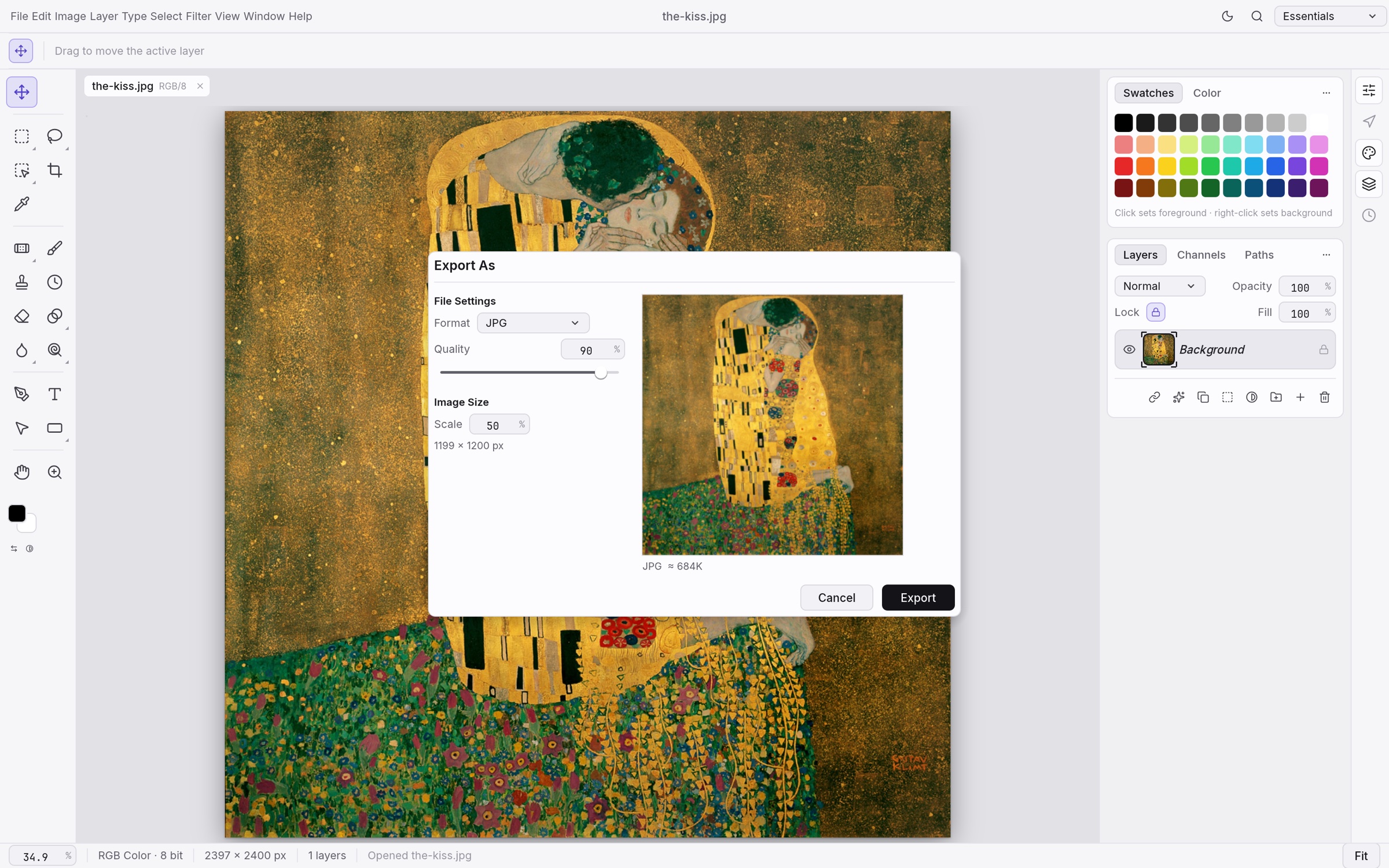
Is PhotoCraft a useful option beside Photoshop? I would decide that around an actual job rather than the resemblance of the interface. For this comparison, the task is to make a promotional image with a photo and a title.
This is a comparison of public documentation. I have not installed both apps and measured them side by side. There is no verified winner, speed advantage or compatibility score in this article. The table separates what is documented from what still needs testing.
What changes in the workflow?
The local editor and command-based workflow are what caught my attention. A command line lets a script request an edit; MCP gives an agent a connection to tools. Neither means every Photoshop feature has an equivalent, or that the app can generate any image you ask for. AI-assisted development, built-in generative features and an agent controlling ordinary editing functions are different things.
| Question | PhotoCraft | What to check against Photoshop |
|---|---|---|
| Development stage | early alpha | The required behaviour in the actual version used |
| Delivery model | Developer describes free, open-source, local work | Official product/plan terms and your workflow requirements |
| Automation | Documented command/agent-control paths | Manual correction needed after a repeated operation |
| Files and results | Supported routes have the limitations discussed below | Save and reopen the same masks, adjustments, fonts and effects in both apps. |
An open-source release lets you inspect the code, but it does not remove time spent learning, checking exports or repairing incompatible files. I have not calculated total cost. Use the linked official baseline page for the relevant regional terms instead of assuming one price applies to everyone.
The file limitation that matters here
The developer describes remaining gaps in generative features, professional typography and plug-in compatibility, and does not present this as a replacement for everyday professional Photoshop work. Opening a PSD is only the first check: masks, adjustments, fonts and effects must also survive saving and reopening. A workflow that depends on a particular Photoshop plug-in needs its own compatibility test.
How I would make the comparison fair
Use the same inputs in both tools: One JPG you took yourself, a short title and a target size of 1080×1080 pixels. Include a Korean title if Korean text is part of your real work.
Keep the output settings, computer, OS and app versions in the record. If one app cannot complete an operation, record where it stopped; do not quietly give only that app an easier input. Separate installation, editing, revision and export time. Errors and manual recovery are part of the workload, even when the final image or document looks good.
| Check | Matched task | Current result |
|---|---|---|
| PSD exchange | Save and reopen the same masks, adjustments, fonts and effects in both apps. | Not hands-on compared |
| Image quality | Compare edges, Korean lettering and colour in equal-size PNGs. | Not hands-on compared |
| Repeated edits | Repeat the same title and size changes, recording manual corrections. | Not hands-on compared |
Agree on what counts as finished
An event date changes, and the title on a promotional image needs updating. If the photo and lettering were flattened into one image, that small change can mean rebuilding the design. PhotoCraft is interesting here because it treats the photo, text and adjustments as separate layers. I would start with that ordinary task before moving a complicated Photoshop project.
The PSD is for the next edit; the PNG is for sharing. Keep both without overwriting the original photo. Reopen the PSD and change one word while leaving the photo intact. Toggle the adjustment layer and inspect masks and fonts as well as the layer list. In the PNG, check the actual pixel dimensions, square crop and readability of Korean characters if you used them.
Producing a delivery file is only one part of completion. Reopening the editable version and making one small change checks whether the next revision remains possible. Keep the first output and the revised one so the difference can be inspected. A source-format round trip also needs a test in the app where the file will actually be received.
Where I would start, and where I would pause
A small layered thumbnail is a useful first exercise. It does not settle whether generative filling, existing plug-ins or a complex PSD delivery workflow will work. If those are the main reason you use Photoshop, test those requirements explicitly before changing your normal process.
For repeated title changes, first prepare a document in which the photo and text can be selected independently. Specify the wording, position and output size separately. Check one image before extending the operation to a batch; automation cannot check that you chose the right original photo on your behalf.
The review can be updated with a hands-on result once there is a record of the installed version, source files, matched settings and failures as well as successes. For now, these are practical comparison criteria based on the checked documents, not observations from a completed benchmark.
Introduction · Task tutorial · Comparison: documented differences
Sources & further reading
- https://getartcraft.com/apps/photocraft
- https://github.com/storytold/photocraft/blob/main/README.md
- https://www.adobe.com/products/photoshop.html
- https://github.com/storytold/photocraft/blob/ed7df56a2455375240959bae6e5273a71d858d84/README.md
- https://github.com/storytold/photocraft/blob/ed7df56a2455375240959bae6e5273a71d858d84/crates/ui-egui/src/menus.rs