Is your scheduled publishing actually completing?
Review schedule time zones, credentials, dry runs, duplicate prevention, recovery, public results, missed runs and limits before automated web or social publishing.
Last updated
Official sources checked:
Did a scheduled post never appear, or did a retry publish it twice? Use GitHub Actions and publishing APIs as examples to review the complete flow. Official features are distinguished from this guide’s operational recommendations. Follow your particular platform’s documentation too. The illustrations are explanatory examples, not evidence of real publication.
CHECK 01 / 8Do schedule and publication use the same time basis?
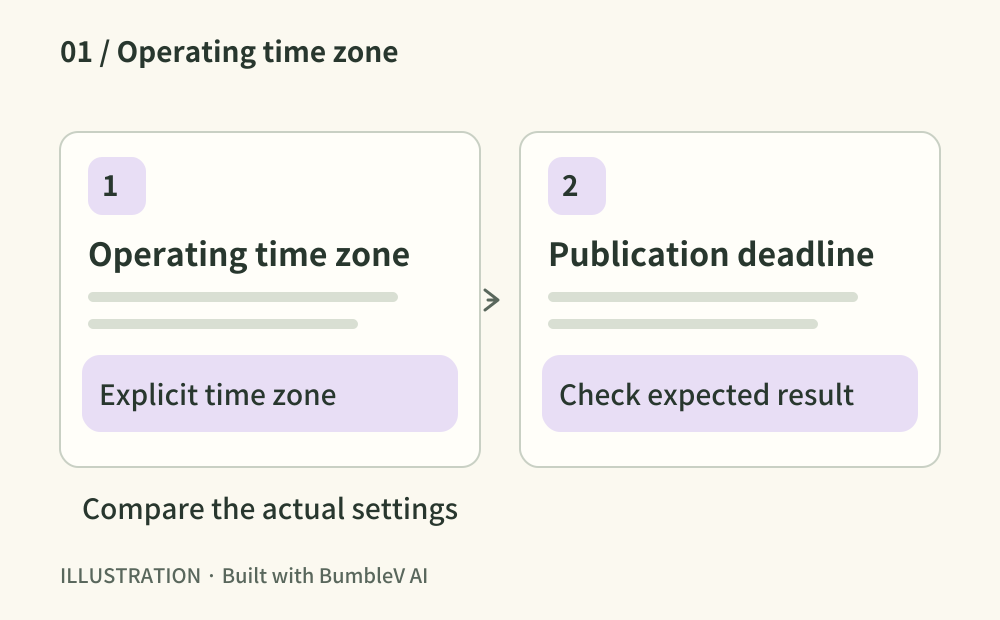
Choose the operating time zone, then inspect the schedule configuration and enabled state on the default branch. GitHub Actions defaults to UTC and also supports explicit time zones. Scheduled runs can be delayed or dropped. Define when a public result is expected so a missing publication can be detected independently of the trigger.
- Where to look
- Schedule file · time zone · default branch · Actions enabled state
- When to tick this check
- The intended local time matches the configuration and an expected publication deadline is defined.
CHECK 02 / 8Do credentials belong to the intended destination?
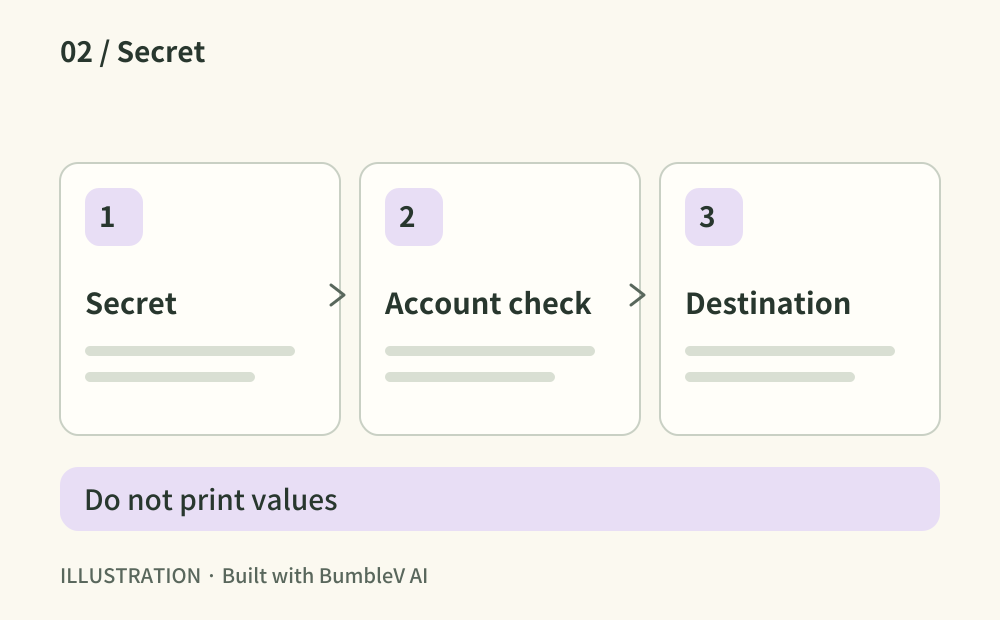
List the intended account, channel and site. Check credential availability in the actual execution environment, then use a read-only account check where supported. Record expiry and renewal. A secret name existing does not prove authentication succeeds. Keep values out of repositories, logs and AI conversations, with only the permissions needed.
- Where to look
- Repository or environment Secrets · account-check API · destination settings
- When to tick this check
- Authentication, destination, required permissions and renewal are verified without exposing values.
CHECK 03 / 8Have you rehearsed without publishing externally?
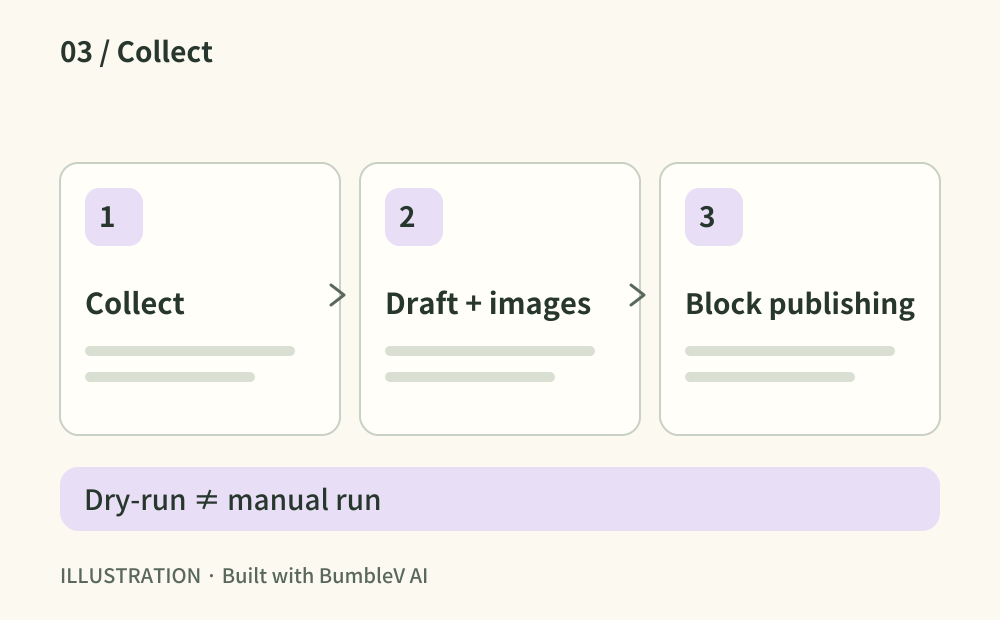
Provide an explicit dry-run path that prepares the draft, images, links and destination details while blocking publication and deployment calls. Review those outputs. Manual workflow dispatch is a way to start a run; it does not itself make a run safe or simulated. This guide recommends retaining evidence that the rehearsal made no external publication.
- Where to look
- Manual inputs · dry-run implementation · draft artifacts and logs
- When to tick this check
- The complete draft is reviewed and the rehearsal is verified to avoid external publication or deployment.
CHECK 04 / 8Can overlapping runs avoid duplicate publication?
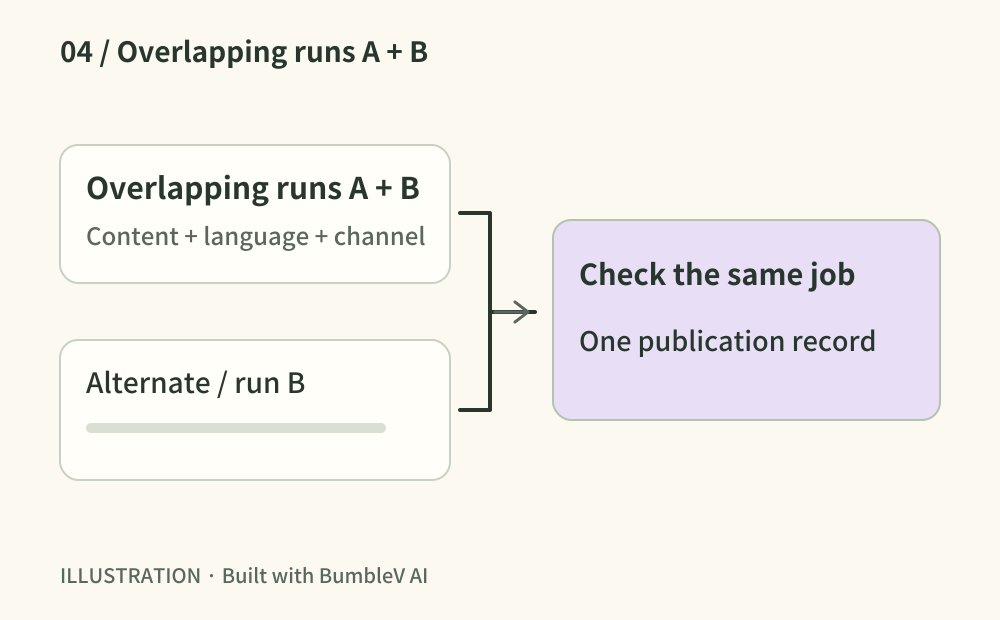
Overlapping runs can pick the same draft. This guide recommends serializing a destination and keeping a durable job ID built from content, language and channel, with publication records. Concurrency control alone does not provide exactly-once publication. Recheck the job before sending and rehearse duplicate input to see that only one publication is prepared.
- Where to look
- Concurrency configuration · job ID · publication records · duplicate-input rehearsal
- When to tick this check
- Overlaps and repeated input are tested with durable records that prevent duplicate publication.
CHECK 05 / 8Does a timeout trigger a safe recovery path?
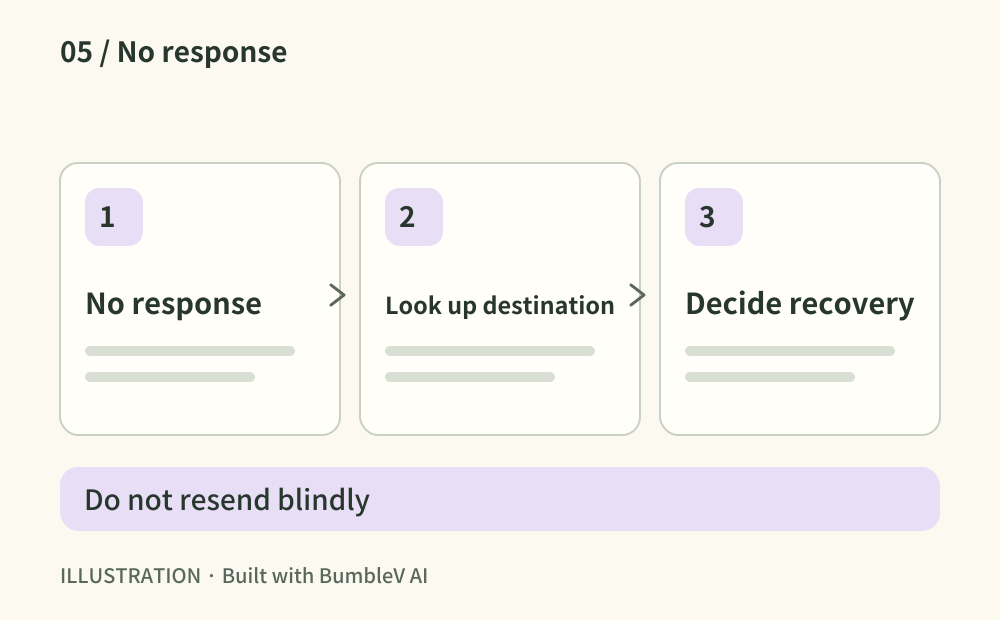
A request can time out after the destination accepted it. This guide recommends an unknown-outcome state and querying destination results before resending. Use idempotency support when the particular API offers it; otherwise hold uncertain publications for reconciliation. Bound retries and respect service-specific Retry-After guidance. Persist completed stages so recovery can resume from the failure.
- Where to look
- API responses · destination lookup · saved stages · bounded retry settings
- When to tick this check
- Unknown and confirmed-failure outcomes are distinguished and lookup, retry and resume paths are rehearsed.
CHECK 06 / 8Does a successful run match the public result?
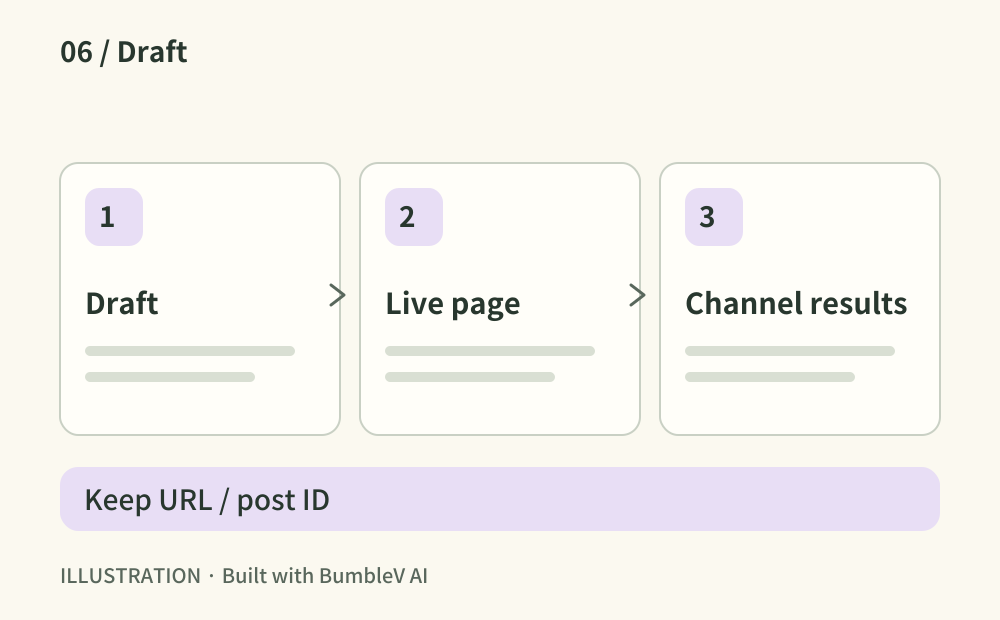
Draft creation, deployment initiation, live-page verification and social publication are separate outcomes. This guide recommends retaining each destination URL or post ID and checking its title, language and image. Record partial completion when one destination fails, then resume only the unfinished one. A zero exit code alone is not proof that every channel published.
- Where to look
- Workflow step logs · deployment result · public URL · channel post IDs
- When to tick this check
- Destination results are verified and recorded as complete, failed or partially complete.
CHECK 07 / 8Can you detect failures and runs that never started?
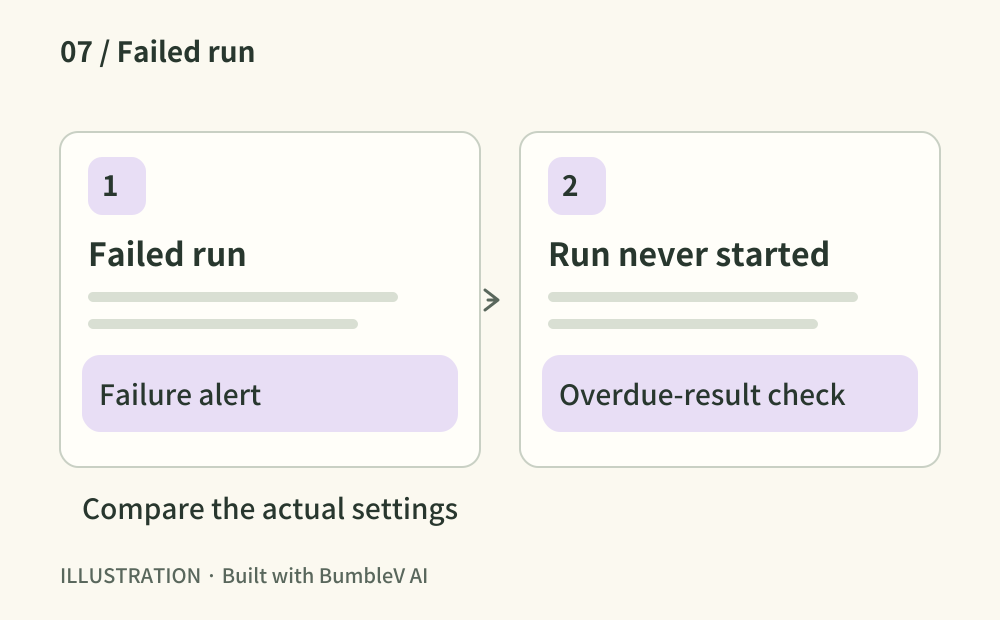
Test delivery of a controlled failure notification. Separately compare the last successful result and expected publication count with the deadline. A run that never starts produces no failed-job log, so this guide recommends an independent overdue-result check. Record whether work was intentionally skipped, prevented as a duplicate or genuinely missed.
- Where to look
- Failure notifications · last success · expected versus observed publications
- When to tick this check
- A test failure notification arrives and a defined check can identify an overdue missing result.
CHECK 08 / 8Are retries, runtime and generation costs bounded?
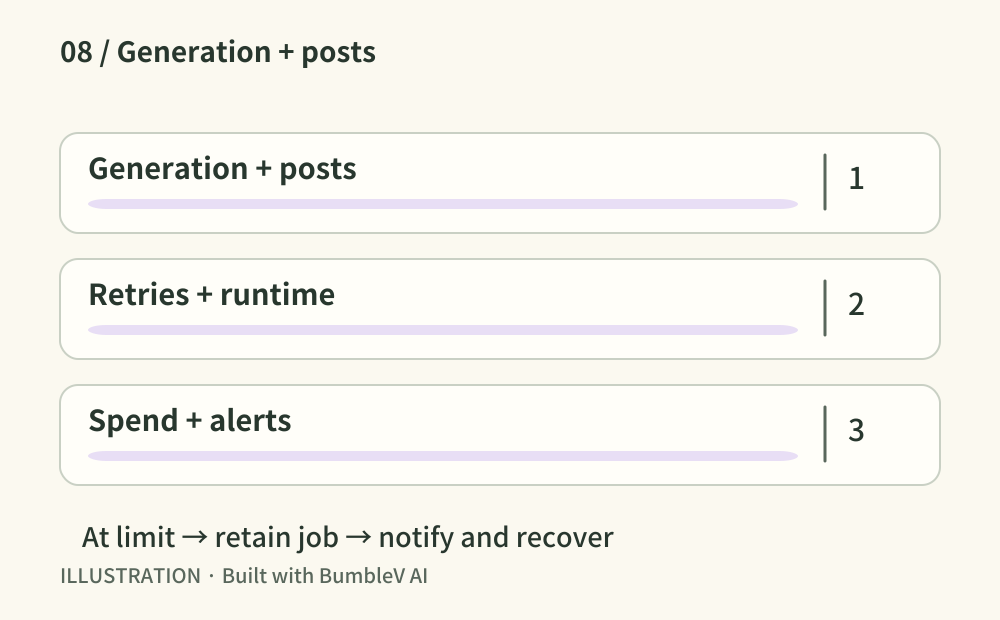
Define daily publications, generation attempts, runtime and paid-API limits. Account for GitHub usage separately from external model or publishing services. This guide recommends recording attempts and usage with an alert threshold. At the limit, retain the unfinished job and notify the operator. Document who restores it and how, so the system does not silently disappear.
- Where to look
- Platform usage · external API billing · attempt counters · recovery procedure
- When to tick this check
- Actual limits are documented and a simulated limit reaches a retained pending state with notification and recovery.
Copy this prompt and paste it into your AI
Replace the placeholders with your URL, tools and current situation. Copy the full text into your AI to request all eight checks, verification of the public result and any remaining account tasks.
Sources & further reading
- https://docs.github.com/en/actions/reference/workflows-and-actions/events-that-trigger-workflows
- https://docs.github.com/en/actions/how-tos/write-workflows/choose-what-workflows-do/use-secrets
- https://docs.github.com/en/actions/how-tos/manage-workflow-runs/manually-run-a-workflow
- https://docs.github.com/en/actions/how-tos/write-workflows/choose-when-workflows-run/control-workflow-concurrency
- https://docs.github.com/en/rest/using-the-rest-api/best-practices-for-using-the-rest-api
- https://docs.github.com/en/actions/how-tos/monitor-workflows/view-workflow-run-history
- https://docs.github.com/en/actions/concepts/workflows-and-actions/notifications-for-workflow-runs
- https://docs.github.com/en/actions/concepts/billing-and-usage