Why I changed the way our AION 2 DPS ranking works
Why PLAYER'S CODEX needed a damage comparison, what went wrong with the first skill model, and how to read the public combat-record tables now.
Last updated
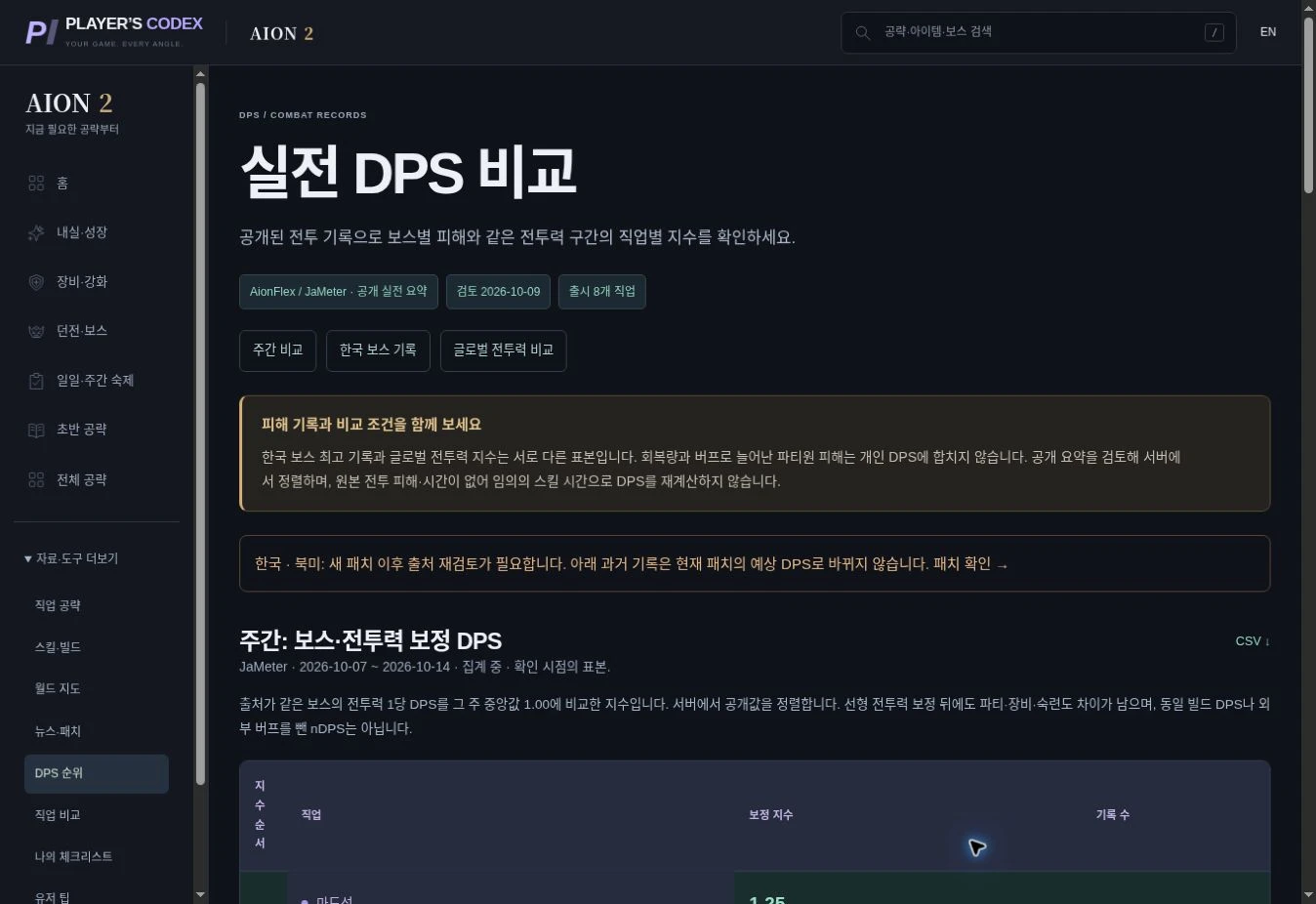
A class introduction answers what a class does, but leaves another question: how much damage does it actually deal? One impressive run from a well-equipped player is not enough to choose a class around. I wanted PLAYER’S CODEX to help people compare damage with the conditions visible beside the numbers.
That is why I added the DPS comparison. DPS means damage per second: damage dealt divided by the relevant combat time. The first goal was to calculate class damage under common conditions and compare it again when skills changed. I also wanted readers to see prepared results, rather than enter every attack and skill value themselves.
Building it exposed a problem: identical input numbers do not automatically make a fair comparison. Here is what changed and how to use the current version.
First, I tried calculating skills
The starting idea was to organise fixed damage, attack coefficients and cooldowns from skill descriptions, then simulate which skill could be used at each time. I asked AI to use guide rotation candidates, fill missing calculations and compare again with common stat inputs.
Direct-damage terms included in the research model increased from 26 to 72 of 96 active skills. The remainder were not all treated as attacks dealing zero damage. Healing, cleansing and buffs were separated from charging or summoned attacks whose timing and damage were not yet resolved.
Activation conditions mattered too. Always allowing a conditional skill can inflate damage; omitting a damage-over-time effect or the direct damage of a setup skill can penalise only one class. The research engine therefore added rules for cooldowns, conditional activation, timed periodic damage and attack-unavailable intervals.
Learning a rotation inside that model is different from finding the best rotation in the actual game. It was not training on raw combat logs from expert players, and equipment, specialisations, Stigmas and measured animation times were not fully verified.
The Cleric-first result made me stop and inspect it
The early formula ranking placed Cleric first. I asked for a proper recalculation and comparison with class builds and other sites’ methods. Applying a penalty just because the class is a healer would not explain the result or fix the next calculation.
The former public model used attack 1,000, known active skills at a common level 20 and synthetic one-second actions. Assassin passive damage and Spiritmaster pet attacks were absent, and Ranger/Sorcerer charged attacks were excluded. Meanwhile, periodic damage made up a large share of the Cleric damage included by the model.
The omissions differed by class. Giving everyone the same attack value did not give everyone equally complete damage coverage. The output could describe the model’s coverage more than the classes themselves.
I withdrew that public formula ranking. The engine and condition-aware rotation experiments remain as research, but cannot publish a final class tier. No arbitrary healer penalty or preferred class order was added. The reasoning is in the October 9 correction record.
The public tool now compares reviewed combat summaries
The current page uses reviewed public summaries from AionFlex and JaMeter. It orders values within a defined comparison scope. Without raw damage totals and full fight times, it does not invent a new DPS from skill timings. Published precision is retained; equal public values share a place.
The tables answer different questions:
| Table | What it compares | Conditions to read |
|---|---|---|
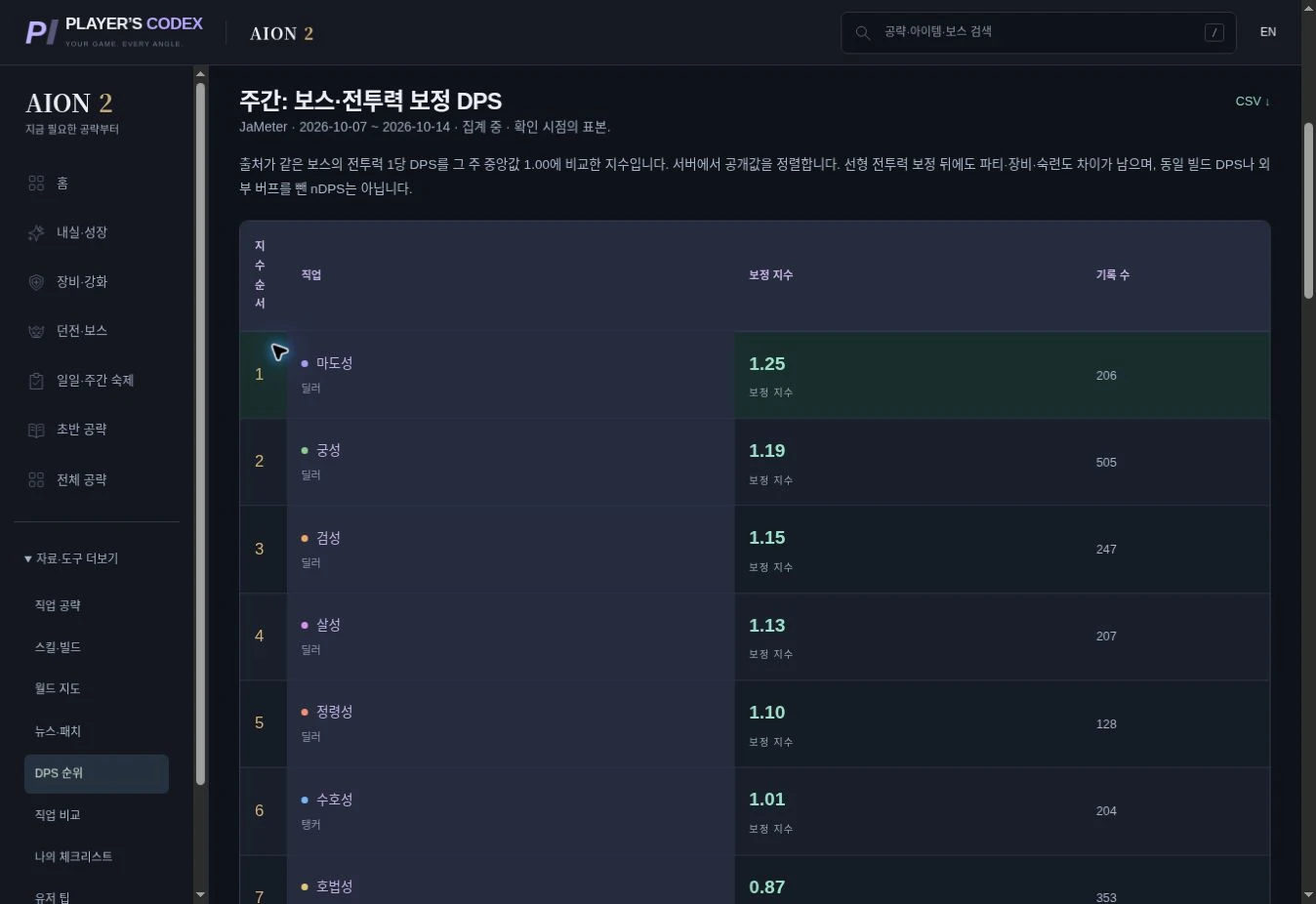
| Weekly | Same-boss DPS per Combat Power against the week’s median of 1.00 | Period, in-progress status and record count |
| Completed week | Published median DPS within a shared Combat-Power band | Historical period and remaining boss/party differences |
| Korea boss records | One highest public class record on the same boss and difficulty | Equipment, dates, buffs and duration are not controlled |
| Global indices | Published median indices within the source’s common Combat-Power band | Baseline 100, region and sample coverage |
A Korea boss-record leader and a Global-index leader can differ because one table orders maximum records and another compares a different set of medians. We do not combine best results from different bosses into an overall DPS or substitute Global values for a missing Korean comparison.
The saved Korea-wide matched comparison has insufficient samples, so it receives no order. Replacing missing data with zero would suggest a class is weak rather than insufficiently observed. The Global normalized-index checks require a common band and, per class, at least 100 character-weeks, 10 uploaders and three qualifying bosses. A character-week represents one character in one week, rather than counting that character’s repeated runs as independent people.
What the tools do
Python reads the public summaries and organises sources, periods, regions and class values. Reviewed inputs are stored in JSON, a structured format for named data. Source URLs and SHA-256 fingerprints are retained so the basis of a published result can be traced.
JavaScript running in Node.js validates the inputs and creates the publication order. It checks eight-class coverage, valid values, regions, periods and sample requirements before exporting JSON and CSV. Python’s page generator then turns those results into HTML tables. CSV is the table file readers can open in a spreadsheet program.
Here, backend calculation means preparing results during the site’s build. A separate server does not simulate fights on every visit. GitHub Pages serves the completed page, so readers do not have to supply character stats. Builds also do not automatically recollect outside data: reviewed inputs must first be updated, then the results generated again.
The responsibilities are visible in the source-review code, ordering code and page renderer. AI helped with development; published values follow the code and reviewed-input rules.
Try the tool in this order
- Open the English DPS comparison, also available from the guide’s DPS navigation entry.
- Read the source-review date and patch notice. Viewing a page today does not make its combat data today’s data.
- Choose Weekly comparisons and inspect the period, adjusted index and record counts. An index of 1.25 is 25% above that table’s 1.00 baseline, not a guarantee of 25% more damage under every build and encounter.
- Expand Completed week: DPS within one Combat-Power band when you want an actual damage-per-second measure. Distinguish that from an index.
- Under Korea boss records, expand Turgen, Griosa or Basilus. Read the posted-record count beside each value.
- Select a class name to open its guide. Use CSV for the comparison data and the source links to inspect the publisher’s method.
Low personal damage does not mean a class has no party value
Personal DPS does not add healing or the extra damage that a buff gives another player. Cleric and Chanter therefore need to be read alongside their party roles. Missing owner attribution can also leave summoned damage out of Sorcerer/Spiritmaster records. The AionFlex methodology and JaMeter metrics explain the underlying reporting scopes.
The improvement is that readers can follow the conditions beside the result: period, boss, maximum versus median and sufficient versus missing coverage. Source links and downloads make that easier to inspect. These are reviewed public aggregates, though; I have not independently verified every underlying raw fight.
To return to the original goal of comparable final builds, we would need actual equipment and skill configurations, full encounter times, pet/proc ownership, buff and patch details, and repeated fights. Those records are not already present merely because a simulation runs. For now, I prefer showing what the available evidence describes. Read the class guides alongside a ranking row when choosing a class.
Article and interface checked October 14, 2026. The stored combat-source review is October 9. Article updates and combat-data refreshes are separate dates.
Sources & further reading
- https://bumblev95.github.io/Aion2-Daeva-Atlas/tools/dps/
- https://github.com/bumblev95/Aion2-Daeva-Atlas/blob/main/research/dps-comparison-correction-2026-10-09.md
- https://github.com/bumblev95/Aion2-Daeva-Atlas/blob/main/scripts/build_dps_rankings.js
- https://aionflex.gg/meta/methodology
- https://jameter.net/metrics